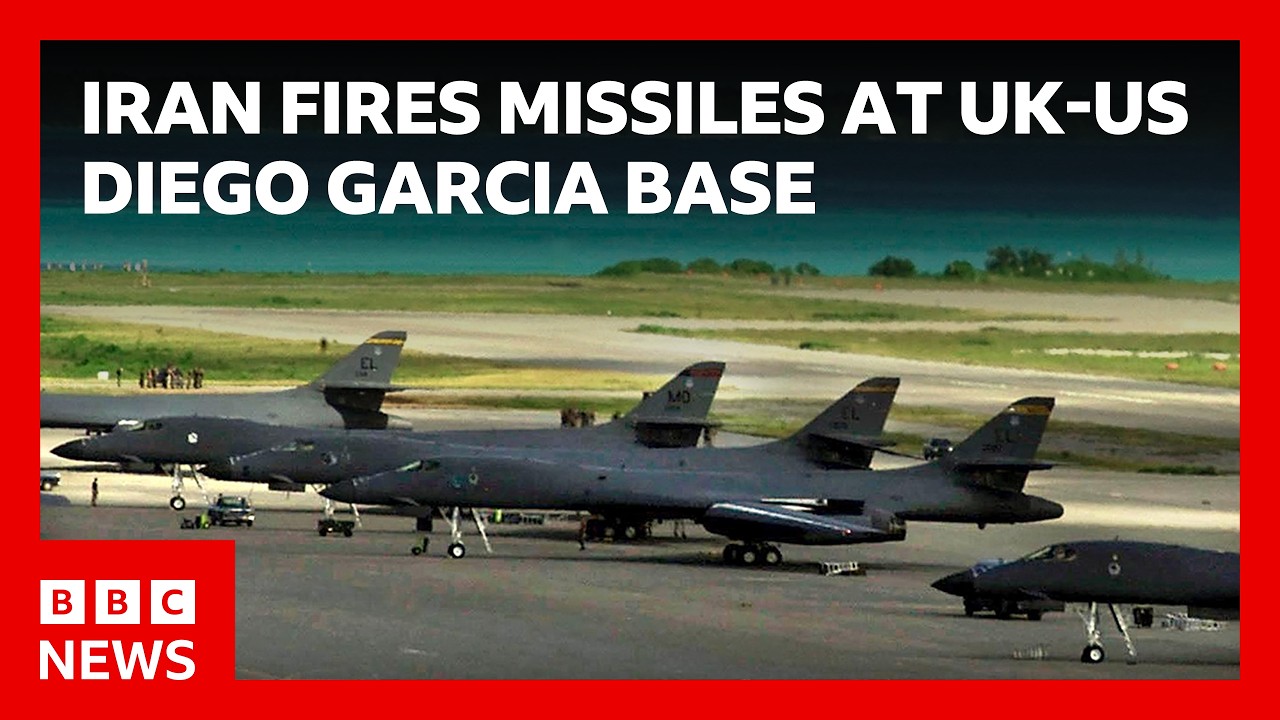
Iran’s Missile Attack on Diego Garcia: A Complex Military Landscape
In a significant escalation of tensions, Iran fired two missiles at the joint British-American military base on Diego Garcia, located in the Indian Ocean. The attack, however, appears to have been unsuccessful, with the missiles falling short of their target. Diego Garcia is nearly 2,400 miles away from Iran—extending beyond the presumed range of Iranian weaponry. This incident raises complex questions about Iran’s military capabilities and its intentions in the region.
The Context of the Attack
The missile launch is believed to have occurred shortly before the UK government permitted the United States to use British bases for operations aimed at countering threats in the vital shipping channel through the Strait of Hormuz. British Prime Minister Keir Starmer’s decision represents a shift in the UK’s position, with implications that some may interpret as significant, while others may see it as subtle. U.S. President Donald Trump, for his part, has expressed dissatisfaction with the UK’s response pace, suggesting that they should have acted "a lot faster."
In Iran, reactions have been fierce. Iranian Foreign Minister Hossein Amir-Abdollahian warned that a change in UK policy could lead to serious consequences, asserting that the nation would exercise its right to self-defense. Such statements underscore Iran’s commitment to escalating its military responses as the geopolitical climate becomes increasingly charged.
Escalating Regional Tensions
In addition to the missile attack on Diego Garcia, the geopolitical landscape remains volatile. Recent reports have indicated that Iranian forces have been actively targeting sites throughout the region, including incidents in Baghdad. Iran’s military actions have undergone a concerning expansion, not only in terms of the targets it chooses but also with respect to the range of its missile capabilities. This marks a troubling development for U.S. diplomatic and military interests in the region.
Moreover, Israeli Defense Minister Israel Katz has contradicted President Trump’s assertions of an impending winding down of U.S. military operations in the Middle East. Katz announced an intensification of U.S.-Israeli military collaboration against what they term the "Iranian terrorist regime," signifying a continued commitment to significant military engagement.
Trump’s Dilemma
President Trump’s statements juxtapose with the on-ground realities that suggest a more complicated military strategy. While he claims the U.S. is nearing its objectives—effectively diminishing Iran’s military capabilities—military planners within the Pentagon are reportedly considering the deployment of ground troops to the region. This apparent contradiction raises questions about the unity and coherence of U.S. strategic objectives.
Despite Trump’s assertions that he would not deploy ground troops, reports indicate that approximately 5,000 U.S. Marines and a contingent of naval forces are being moved to the region. This military buildup hints at a possible strategy of deterrence, aimed at stabilizing the situation and countering Iranian aggression but raises questions about the long-term commitment of U.S. forces.
UK’s Defensive Stance
The UK’s military posture now seems to reflect a nuanced shift from purely defensive operations to allowing the U.S. greater freedom in its military actions. Critiques from within the UK Parliament are emerging, with both opposition parties and some government members expressing concerns about the implications of this change in policy. As discussions unfold, the balance between national security and public opinion regarding military engagements will become increasingly scrutinized.
Conclusion
The missile attack on Diego Garcia serves as a stark reminder of the dangerous interplay between military capabilities and international diplomacy. While the U.S. and its allies continue to bolster their positions in response to Iranian provocations, the broader implications of these military maneuvers reflect a complex, unwieldy geopolitical situation. As the UK adjusts its military policy and the U.S. recalibrates its strategic objectives, the potential for further escalation cannot be overlooked. In this fraught environment, achieving a lasting resolution may prove to be significantly more challenging than initiating military responses.