Protests Erupt in Downtown Toronto Amid Tension Over Iran’s Future
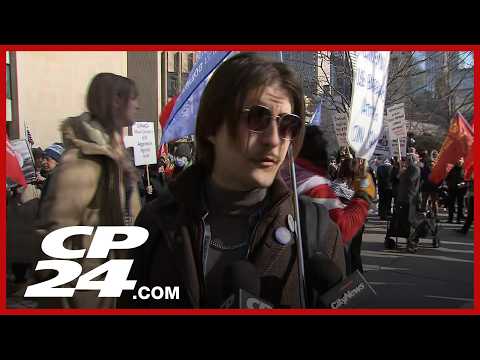
As the situation in Iran continues to shift, the streets of downtown Toronto resonate with a cacophony of opinions and emotions. Demonstrators, drawn together by diverse motivations, have gathered outside the U.S. consulate to express their stances on the unfolding events overseas. The protests reflect a broader discontent, not only with U.S. foreign policy but also with the complexities of regime change in Iran.
At the forefront of the protest is the uncertainty surrounding the fate of Iran’s Supreme Leader, Ayatollah Ali Khamenei. Reports indicate he may have been killed in recent airstrikes, sparking varied reactions among onlookers. Andrew Brennan, a reporter on the scene, details the atmosphere: “Even as we witness a predominately anti-war demonstration, diverging opinions surface among participants.” Clearly, not everyone agrees on the objectives or implications of the ongoing unrest in Iran.
The demonstration’s tone is largely anti-war, yet the motivations behind the participants vary widely. While some attendees advocate for an end to hostilities, others express explicit support for regime change, highlighting the complexities of the current geopolitical landscape. This differentiation underscores the way individuals experience and interpret international conflicts.
Andrew notes a palpable tension within the crowd as police have created barriers, likely in anticipation of potential unrest. A smaller group expressing support for the new political changes in Iran has faced vocal opposition. The back-and-forth exchange has even led to confrontations, emphasizing the high stakes involved as people passionately assert their beliefs.
In conversations with attendees, the varied motivations unfold. A young organizer firmly against the Iranian regime, surprisingly, does not support foreign intervention by the U.S. or Israel. “It’s our responsibility to determine our own future,” he asserts, underscoring a nuanced understanding of sovereignty amidst calls for change. His perspective challenges the narrative of unilateral intervention and echoes a desire for internal self-determination.
Another protestor, Jared, articulated broader concerns surrounding U.S. foreign policy, positing that the current discourse is about far more than Iran. He connected the events in Iran to a larger theme of sovereignty issues shared by nations like Venezuela and Cuba. “This is about the United States undermining the sovereignty of nations,” he argued, reflecting a sense of solidarity among nations facing external challenges.
The palpable tension intensifies as some voices are particularly critical of U.S. motives. “They don’t care about democracy; this is another war for oil,” asserted a protestor who linked the situation in Iran to perceived injustices faced by other nations. These sentiments highlight a skepticism regarding the intentions of powerful nations that present themselves as advocates for democracy while pursuing their own geopolitical goals.
Personal narratives amplify the discourse. A woman named Miriam stood for peace, her emotional connection fueled by past experiences in Beirut. Displaying photographs of her home, she articulated a fear of conflict drawing on the personal, familial, and geographical implications of war. Her visceral anger directed at both the U.S. and Israel encapsulated a broader anxiety that transcends borders—complexity and interconnectedness in the realm of international affairs.
The demonstration, while at times heated, has thus far remained non-violent—a testament to the disciplined expression of dissent in public spaces. Despite the divergent views, participants share a fundamental opposition to violence, emphasizing dialogue, sovereignty, and self-determination as their underlying motivations.
As the future of Iran remains uncertain, the protests in Toronto serve as a microcosm of the wider global discourse on intervention, regime change, and the quest for genuine democracy. The complexity of individual perspectives challenges simplistic narratives, painting a rich tapestry of human emotion, fear, hope, and resilience as people contemplate the ramifications of the choices made today.
Thus, the streets of Toronto echo not only with demands for peace but also with the urgent, multifaceted call for sovereignty and respect in global deliberations. The dialogue continues, and as history unfolds, the collective voices cannot be ignored.