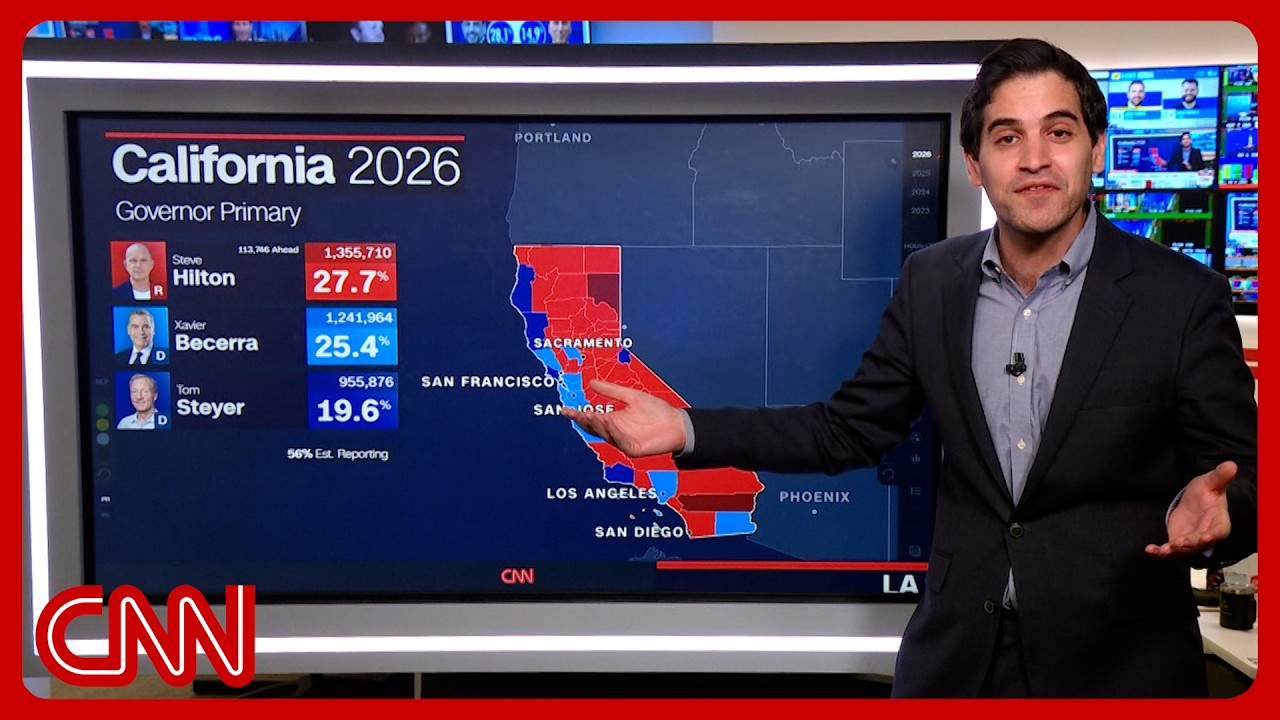
As California’s primary elections unfold, the political landscape remains fluid and dynamic. Current projections indicate a competitive race, with Republican Steve Hilton leading, followed closely by Democrat Javier Becerra. Billionaire Tom Steyer trails in third position. With approximately 56% of the vote counted, significant portions of ballots still await processing, leaving ample room for changes in standings as the results finalize.
Harry Enten, CNN’s chief data analyst, highlights the narrow margins separating these candidates. Hilton holds a slight lead with 27.7% of the vote, while Becerra stands at 25.4%, and Steyer lags with 19.6%. The remaining 44% of the vote to be counted may be crucial, particularly since historical trends show late-counted ballots often skew Democratic. This raises critical questions about whether Steyer can leverage remaining votes to shift the balance and if Hilton and Becerra can maintain their current standings.
Engagement in this election has been robust, underscored by data revealing millions of votes cast. Enten points to a projected turnout of around 1.2 to 1.3 million, affirming voter enthusiasm. Yet, where those uncounted votes will derive from is pivotal in shaping the outcome, particularly for Steyer, who may have potential in Democratic-leaning constituencies—specifically in areas surrounding San Francisco, his home base.
The stakes extend beyond the governor’s race, tying into California’s broader political fabric. The 11th Congressional District, seeking to fill the void left by the departure of Nancy Pelosi, features Connie Chan, a candidate endorsed by Pelosi herself, currently positioned to advance to the general election. Chan’s competition stems from a notable figure, Alexandria Ocasio-Cortez’s former chief of staff, who, despite a relatively lesser-known status, has invested substantially in his campaign. The dynamics here further illustrate the complexities within the Democratic Party, particularly in areas that lean more progressive.
The Los Angeles mayoral race adds another layer of intrigue. Incumbent Karen Bass has secured a spot in the runoff with a 35.8% share of the votes thus far. Spencer Pratt, who receives support primarily from Republican factions, has emerged as a contender, but his lead has been narrowing as Nydia Rahman, another Democrat, closes the gap. Enten suggests that should the late-counted ballots follow trends from previous elections, Bass’s position could fortify, particularly if voters align against Pratt.
The implications of these races extend beyond individual candidates. Voter frustration with economic conditions serves as an undercurrent in this election cycle. Issues such as homelessness and public safety have fostered an environment where voters are selectively strategic in their choices, a scenario exacerbated by a nonpartisan primary system that complicates voter decision-making.
Enten emphasizes the concept of the “red mirage,” a phenomenon where initial results may favor Republicans before late-arriving ballots shift the narrative. In California, this could reveal a deeper dissatisfaction with the status quo, particularly among Democratic voters, thus reshaping electoral expectations as more votes come in.
In this intricate political tapestry, the ongoing rise of artificial intelligence in campaign advertising further complicates traditional political narratives, offering candidates new tools to connect with voters and influence perceptions. This innovative approach, particularly visible in the mayoral race, underscores the increasingly sophisticated tactics employed by candidates across the spectrum.
As California continues to process votes, the outcomes may not only determine the future leadership of the state but also reflect broader trends in American political engagement. The evolving landscape offers a vivid snapshot of contemporary democracy, marked by voters’ strategic decision-making and the interplay of emerging technologies and traditional campaigning. In the weeks to come, as results stabilize, Californians and analysts alike will be watching closely to discern the implications for both local and national politics.