Escalation of Tensions: Romanian Apartment Block Hit by Russian Drone
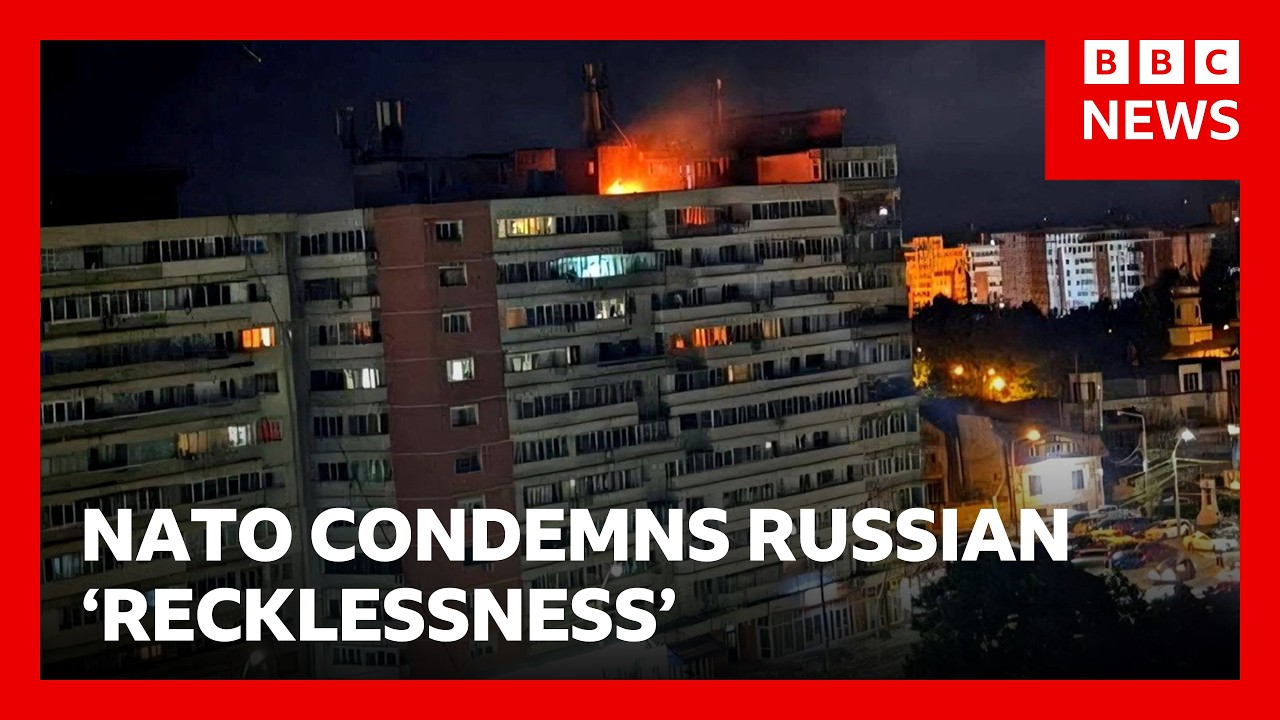
In a significant escalation of military tensions in Eastern Europe, a Russian drone recently crashed into an apartment block in Galati, Romania. This incident marks a sobering first; it is the first time citizens of the NATO member state have been injured by what was initially reported as fragments from Russian drones. A 54-year-old woman and her 14-year-old son were among the injured, with the explosion igniting a fire that led to the evacuation of approximately 70 residents from the ten-story building. This event has prompted a wave of condemnation from European leaders, showcasing the rising stakes in the ongoing conflict between Russia and Ukraine.
The Romanian government has responded assertively. Bucharest has summoned the Russian ambassador to account for this reckless act, with President Klaus Iohannis convening an emergency meeting of the Supreme Defense Council. The seriousness of the situation is underscored by NATO’s condemnation, with Secretary-General Jens Stoltenberg reiterating that Russia’s irresponsible behavior poses a threat to all member states and assuring comprehensive solidarity with Romania.
Nick Thorpe, our correspondent reporting from Hungary, elaborated on the rapid sequence of events that led to the attack. The drone was detected by Romanian security forces around 2:00 a.m. local time, yet within four minutes, it struck residential territory. Notably, this was not merely a fragment from previous incursions but an armed drone that detonated on impact. The implications of this event extend beyond immediate injuries; it raises profound questions about Romania’s national security and NATO’s collective defense commitments.
Further complicating the analysis is the historical context of Galati as a significant port city along the Danube River. It serves vital logistical supply lines, most crucially for grain exports from Ukraine. With the nearest recognized military target in Ukraine located 18 kilometers from the site of the explosion, skepticism abounds about whether this was a mere act of miscalculation. Some defense analysts are theorizing that the drone attack may represent a trial run of Romania’s defense capabilities, testing the preparedness of NATO in the face of a potential escalation.
Militarily, the situation remains nuanced. Analysts note that Romania’s response options under NATO’s Article 5—a collective defense clause requiring mutual support—may be limited at this stage. The drone’s incursion can be classified as a one-off incident, which may not compel NATO to invoke its collective defense obligations. Instead, the Romanian military is left grappling with the complexities of response under these precarious conditions.
A critical factor in the equation is the evolving nature of drone warfare. As reported, the type of drones being used—specifically Iran-manufactured Geran-2—originates from technologies adapted in combat scenarios thousands of kilometers away. The operational challenges for Romania include the drones’ low-altitude capabilities, which complicate interception efforts. Two Romanian F-16s reportedly scrambled in response, but their effectiveness was hampered by the drone’s unique flight characteristics and the challenges of urban engagement. These circumstances raise critical questions about the readiness of air defense systems and the protective layers in place for civilian populations.
As investigations continue into the specifics of this incident, public sentiment in Romania is likely to shift towards a demand for stronger preventative measures against future threats. The mere fact of injuries to civilians has heightened awareness of the precarious geopolitical landscape in the region.
In summation, the drone strike in Galati has not only underscored the vulnerabilities within Romanian airspace but has also ignited a significant diplomatic furor. As European leaders rally in condemnation and NATO stands firm in its solidarity, the implications of this incident resonate far beyond national borders, heralding a new phase of vigilance and potential escalation in an already fraught geopolitical environment. The world watches closely as Romania navigates this precarious situation, reflecting a broader chess game in Eastern Europe that continues to unfold.