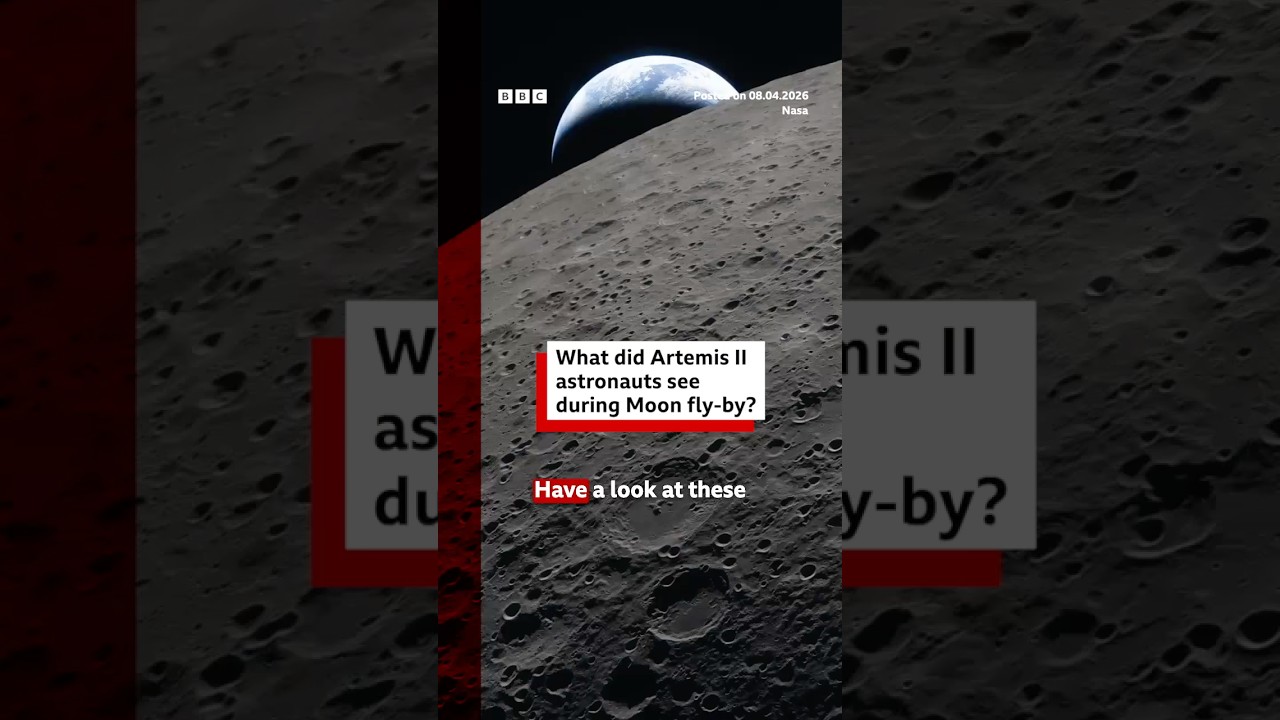
Astronauts Capture Rare Glimpses of the Moon’s Far Side
Recently, the Arteimus astronauts returned from an exhilarating mission, beaming back a series of remarkable images taken from a quarter of a million miles away. These photographs offer an unprecedented view of the moon’s far side—an area that has long remained hidden from human eyes. As scientists and the world gaze upon these visuals, the excitement in mission control is palpable.
Among the stark features of the lunar surface revealed in these images are immense craters, each telling a story of the moon’s tumultuous history. The lunar landscape is characterized by rugged terrain, and the contrast between the bright side bathed in sunlight and the enveloped shadows offers a striking view of the boundary between day and night on the moon. This separation, often referred to as the "terminator line," is an area of stark visual drama, enhancing our understanding of lunar geography.
But the images do not focus solely on the moon; they also capture our home planet, Earth, as it appears to recede behind the moon’s desolate terrain. This juxtaposition serves as a poignant reminder of our cosmic proximity and the vastness of space. In that moment, Earth appears both familiar and so far away, evoking a sense of wonder and humility in those who behold these images.
Adding to the unique experiences offered by this mission, the astronauts had the rare opportunity to witness a solar eclipse that was theirs alone. With their specialized eclipse glasses, they were able to observe the sun being obscured by the moon. In the expansive blackness of space, the sun’s outer atmosphere glimmered and shimmered, creating a breathtaking spectacle—an extraordinary visual reward for the crew that few have had the privilege to witness in such a setting.
The implications of these images are significant. For scientists based at mission control, this visual data is a treasure trove that promises to transform our understanding of the moon. The far side of the moon, previously beyond the reach of direct human observation, holds crucial clues to lunar geology and cosmology. The astronauts didn’t merely capture pictures; they embarked on a scientific endeavor that will occupy their team for months and possibly even years.
The crew took thousands of photographs during their time in orbit. Each image represents meticulous documentation of a celestial body that has fascinated humanity for centuries. Scientists are eager to analyze both macro and micro-level details, from the huge craters that dot the lunar landscape to the subtle textures that characterize the rock and dust. These insights could provide a better understanding of the moon’s formation and its geological evolution over the millennia.
Moreover, this mission stands as a testament to human ingenuity and determination. It exemplifies the collective aspiration to explore the unknown and to push the boundaries of our knowledge. With every mission, we inch closer to unraveling the mysteries of not just the moon, but of our place in the universe. This venture reflects an era where humanity is actively venturing into space, driven by both curiosity and the promise of discovery.
As the analysis begins, each photo taken will be scrutinized and interpreted, and with it, new theories and understandings of our closest celestial neighbor will emerge. The far side of the moon is not just a frontier; it is a canvas that could reveal details about our early solar system, and perhaps, insights into the very foundation of planetary formation.
In conclusion, the Arteimus astronauts have gifted us more than just stunning visuals; they have provided scientific content that could reshape our lunar knowledge. This mission is an invitation to look deeper, to learn more, and to remember that the universe holds many secrets waiting to be discovered. The journey of exploration is ongoing, and with each image and each analysis, we are reminded of the infinite potential that lies beyond our atmosphere.