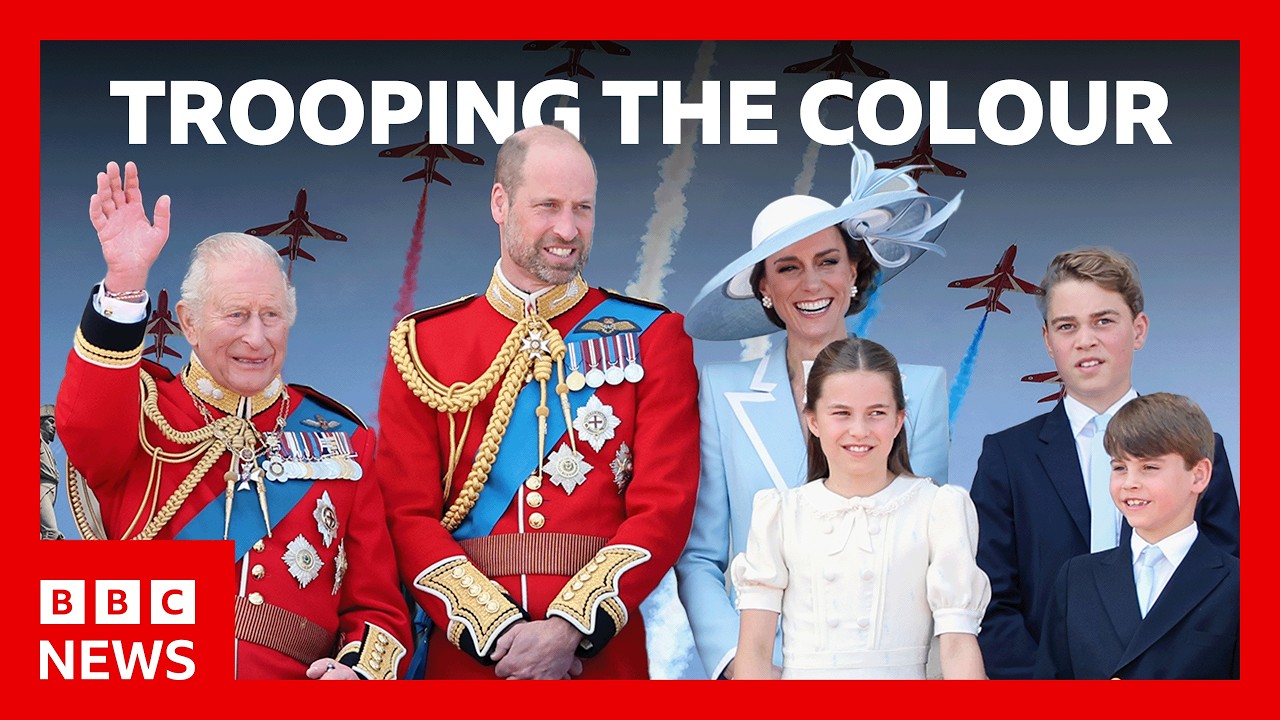
Celebrating Tradition: The Majesty of Trooping the Colour in London
In the heart of London, the historical grandeur of Trooping the Colour unfolded recently, marking the King’s official birthday. This annual event draws thousands to the Mall, where spectators eagerly await a glimpse of the royal family. The air buzzed with excitement and anticipation as members of the public, some arriving in the early hours, found their spots along the route.
The ceremony is a testament to the British Army’s ceremonial expertise. This year, the Grenadier Guards led the parade, proudly receiving new colors from His Majesty, who serves as the regiment’s Colonel-in-Chief. The significance of this act cannot be overstated. For both the royal family and the soldiers, it symbolizes a bond steeped in history and tradition.
In addition to the colorful displays, the Princess of Wales took center stage alongside her three children: Prince George, Princess Charlotte, and Prince Louis. Their presence signaled a renewed commitment to royal duties, emphasizing the importance of familial ties within the monarchy. As they traveled in their carriage, the children’s delight was palpable, showcasing an innocence that adds warmth to the annual celebration.
Just a stone’s throw from Buckingham Palace, the event crescendoed with a traditional 41-gun salute from Green Park, executed flawlessly by the King’s Troop Royal Horse Artillery. The sound reverberated across the gathering, an auditory manifestation of respect and honor. Each boom of the cannons added to the sense of occasion, evoking a shared pride among the attendees.
As the ceremony progressed, members of the royal family gathered on the grand balcony of Buckingham Palace, poised to witness the anticipated flypast by the Royal Air Force. The atmosphere was electric. Crowds erupted into cheers as 29 aircraft, including powerful Typhoon jets, an F-35, and the iconic Red Arrows, soared across the sky. Their formations were a striking reminder of the harmony between tradition and modernity in British culture.
The Red Arrows, with their vivid red, white, and blue trails, capped off the display in dramatic fashion, a visual spectacle that left many breathless. But the day wasn’t solely about celebration; it also reflected the tumultuous period the royal family has navigated recently, notably fueled by ongoing scandals involving Prince Andrew. These complex dynamics did not overshadow the day’s festivities but rather highlighted the resilience of the monarchy amidst scrutiny.
While the cheers of support filled the air, a small but vocal group of anti-monarchy protesters made their presence known with yellow flags, reminding onlookers that not all sentiments towards the Royal Family are uniform. Nonetheless, the juxtaposition of support and dissent presented a microcosm of contemporary British society, illustrating that the monarchy, like any institution, is not above debate.
As the royal family waved to the well-wishers below, the image of unity and celebration remained intact. The children’s animated chatter was a heartwarming contrast to the pomp surrounding them. Their engagement with the crowd bridges the gap between traditional royal duties and the everyday realities of British life.
In summary, Trooping the Colour is not merely a historic spectacle; it serves as a moment of national reflection and pride. The event encapsulates the virtues of service, duty, and family, underscoring the significance of the monarchy as it evolves in a modern context. Despite the challenges, the celebration exuded a powerful sense of connection—between the royal family and the public, between history and the present, and ultimately, between tradition and the future.
As participants and onlookers alike return home from this day of pageantry, many will carry with them the energy and warmth generated from a shared celebration, etched into the fabric of British culture, one troop at a time.