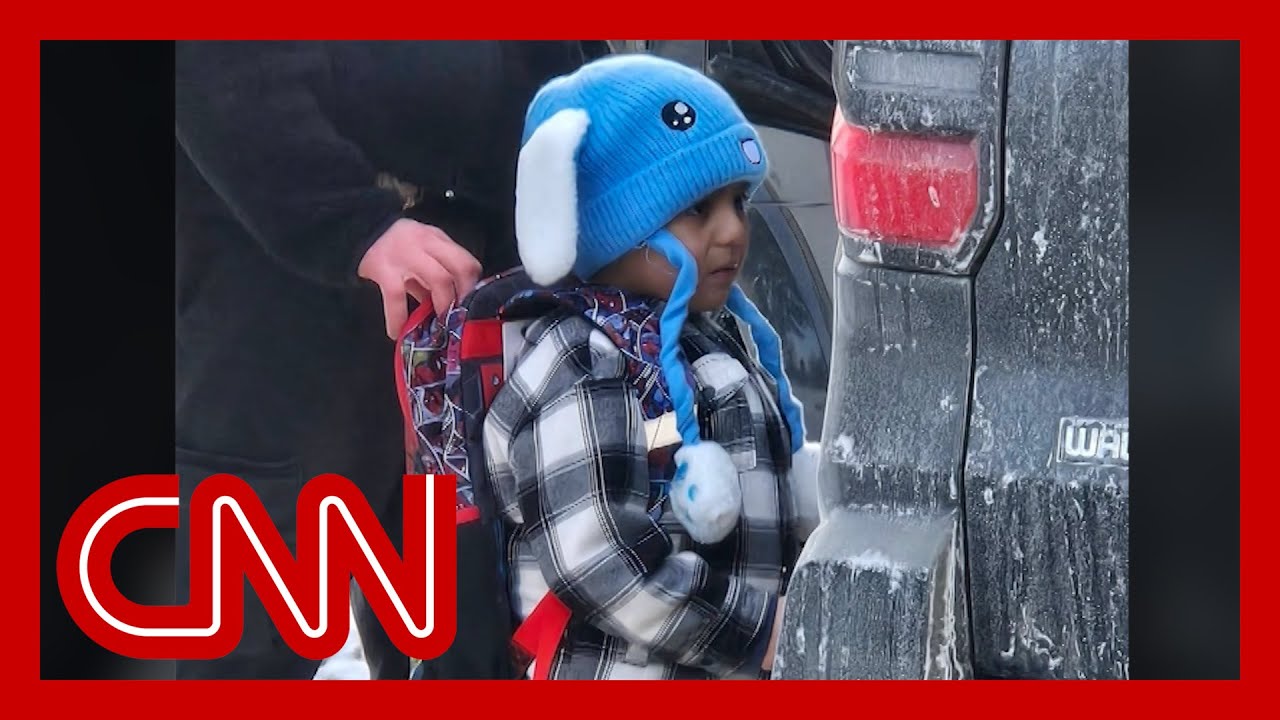
On a typical Tuesday afternoon, five-year-old Liam Kanejo Romis found himself thrust into a disturbing and chaotic situation that encapsulates the complex dynamics surrounding immigration enforcement in the United States. After returning home from preschool, Liam’s life took an unexpected turn as officers from U.S. Immigration and Customs Enforcement (ICE) approached his family’s driveway, leading to an event that many in Minneapolis would describe as emblematic of the current immigration climate.
The Department of Homeland Security (DHS) claims they were targeting Liam’s father, an undocumented immigrant from Ecuador. According to their account, when approached by ICE agents, the father fled, leaving his child behind. Both father and son were subsequently taken into custody. This act has sparked outrage and concern, particularly as the local community watches a growing number of similar incidents unfold in recent weeks, with Liam being one of four students from the same school district detained by ICE.
Critics of the incident, including legal advocates and local officials, argue that the situation could have been handled with more sensitivity. Eyewitness accounts suggest that there were adults nearby prepared to take custody of Liam, raising questions about why federal agents did not allow for a safer alternative to separating a young child from his family. Some onlookers reported hearing cries for compassion, questioning the morality of treating a child as mere collateral in an immigration operation.
Vice President Kamala Harris, acknowledging the gravity of the situation, described the incident as troubling upon hearing about it. Meanwhile, others, such as Senator Tina Smith, emphasized that Liam’s father is actively pursuing an asylum case in the United States and thus should not be classified as an illegal immigrant. This distinction brings to light the complexities of immigration laws and the nuances that inform individual cases.
In a contrasting viewpoint, Republican Senator J.D. Vance asserted that the father’s undocumented status warranted the actions taken by ICE. He suggested that while the image of a child being detained evokes strong emotional reactions, the underlying facts of the father’s immigration status cannot be overlooked. Vance’s commentary reflects a broader perspective often utilized in political discourse surrounding immigration enforcement, where the emphasis tends to be on the legality rather than the human element.
The school district has released a video capturing the moment of Liam’s detention, illustrating the chaos that transpired in the driveway. Such videos have become increasingly common as more families find themselves ensnared in the web of immigration enforcement actions. As community members rally in response, they echo sentiments of concern and frustration, questioning the humanity of a system that allows such scenarios to unfold. “Where’s your humanity?” was a refrain heard amidst the commotion, highlighting a public plea for compassion and understanding in a system perceived as increasingly punitive.
In subsequent developments, the Justice Department arrested three protestors who disrupted a church service in St. Paul, advocating against ICE’s local operations. This incident adds another layer to the ongoing tensions between immigrant families and federal enforcement agencies, stirring further debate about safety and rights in local communities.
As the discourse surrounding immigration enforcement continues to evolve, there remains a palpable tension between the rule of law and the moral obligations of government agencies. The case of Liam and his father underscores the urgent need for a humane approach that prioritizes the welfare of children and families within immigration policy.
Ultimately, the incident serves as a reminder of the complexities and challenges faced by immigrant communities in America. With mounting public scrutiny, local officials, advocates, and families will likely continue to push for reform, seeking to ensure that federal actions do not overshadow the fundamental rights and humanity of individuals seeking refuge and a better life.