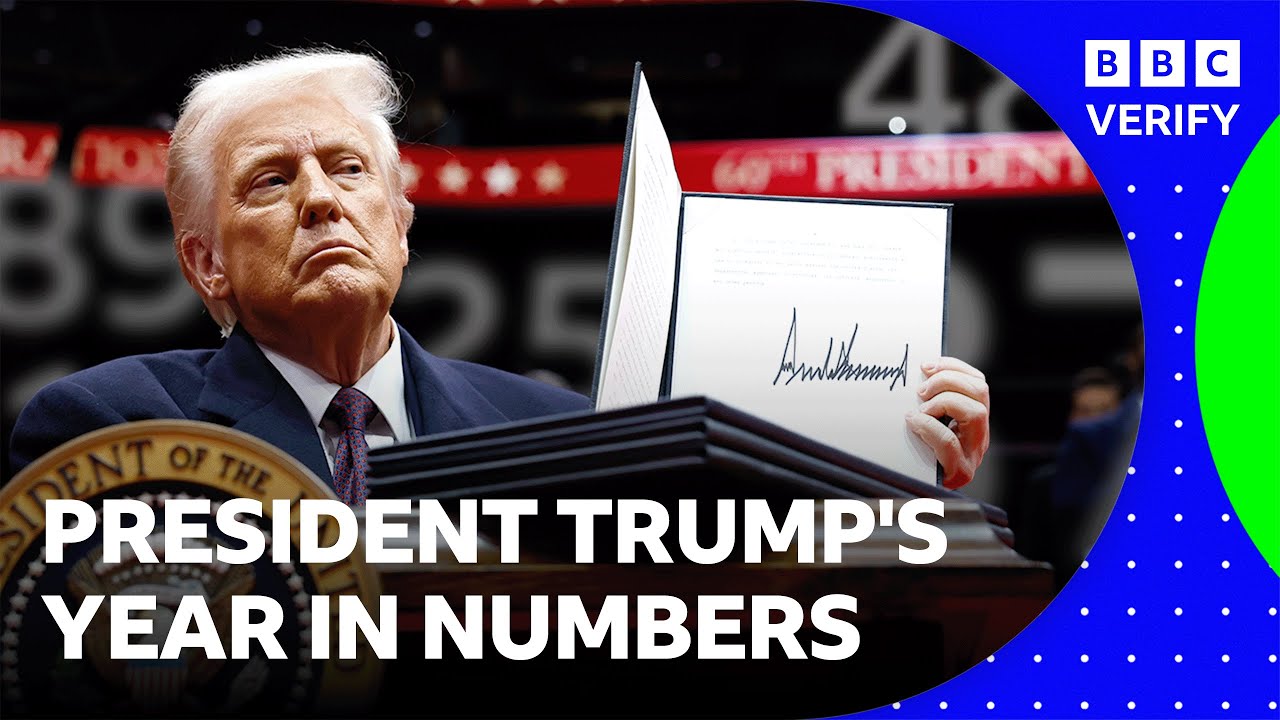
President Trump’s First Year: A Statistical Overview
As we assess the first year of Donald Trump’s presidency, the numbers tell a compelling story of leadership marked by immediate actions, executive authority, and a polarized response. From executive orders to foreign trips, Trump’s inaugural year unfolds in figures that reflect a distinctive approach to governance.
Executive Orders and Pardons
One of the most striking aspects of Trump’s presidency is his reliance on executive orders. In his first year alone, he signed 225 orders, a significant contrast to the 77 signed by Joe Biden during his first year. Notably, Trump set a record on his first day in office, issuing 26 executive orders—more than any previous president on a single day. This early flurry of activity established a tone of decisiveness, positioning his administration as one willing to bypass traditional legislative processes.
The issuance of pardons adds another layer to the president’s legal maneuvering. Shortly after the January 6 riots in 2021, Trump controversially pardoned over 1,500 individuals convicted in connection with those events. This included a range of offenses, from assaults on law enforcement to obstruction of Congress. In comparison, Biden made no pardons in his first year, ultimately issuing a total of 80 throughout his term, including one for his son, Hunter, shortly before leaving office.
Foreign Trips and Domestic Engagement
Trump’s first year also included a robust travel schedule, reflecting his commitment to international diplomacy. He visited 13 countries, notably attending Pope Francis’s funeral in Vatican City and promoting trade agreements in the UK. His trip to Israel featured an address to the Knesset, solidifying his administration’s strong ties with the nation. Closer to home, Trump traveled to 17 states, with Virginia topping the list at 34 visits, primarily to his properties, including a golf club. Florida, home to his Mar-a-Lago estate, welcomed Trump around 19 times, highlighting a blend of personal interests with his presidential duties.
Communication Strategies
Trump’s communication strategy differed markedly from that of his predecessor. He made headlines with his frequent media engagements, granting 26 interviews within the first 100 days—mostly to conservative outlets. By contrast, Biden participated in 22 interviews during his initial year. Trump’s direct engagement with the public also extended to social media; most notably, he utilized Truth Social to disseminate a wide range of content, including official statements and informal memes. Notably, December saw him posting a staggering 615 times, averaging over 160 posts in just five hours.
National Security Responses
On the domestic front, Trump’s administration wasn’t without controversy. He ordered six deployments of the National Guard to various U.S. cities aimed at maintaining law and order. While troops were deployed in locations like Los Angeles, Washington, D.C., Memphis, and New Orleans, legal challenges prevented military presence in Chicago and Portland.
Looking Ahead
With just one year completed, Trump’s presidency remains under intense scrutiny. Supporters and critics alike are acutely aware that with three years remaining, the trajectory of Trump’s policies and actions is far from finalized. The figures from his first year present a blend of assertive governance and contentious decisions, suggesting that the coming years will likely mirror this divisive landscape.
In reviewing Trump’s first year through this quantitative lens, one can glean insights about his leadership style and overarching priorities. His significant use of executive power, extensive travels, and active media presence illustrate a distinct approach that diverges sharply from traditional norms. As the administration continues, it remains to be seen how these early choices will shape the future of U.S. politics and governance.