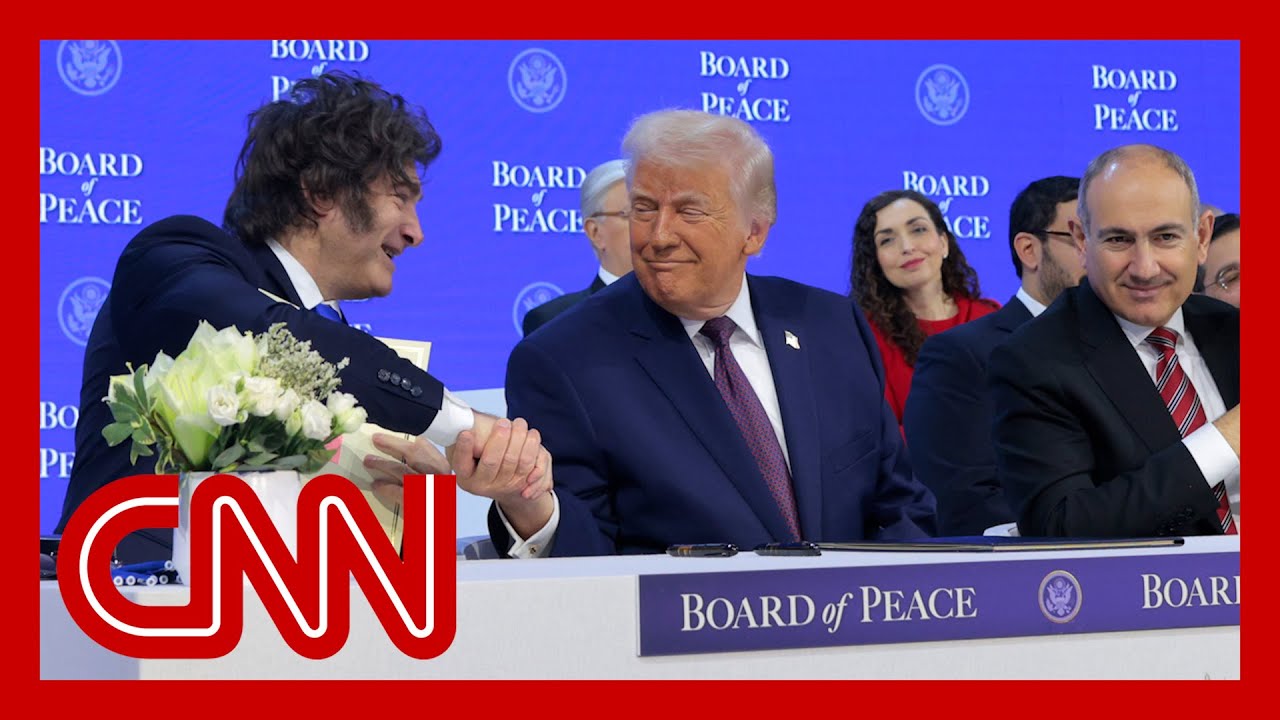
A Fresh Approach at Davos: The Board of Peace and Global Diplomacy
President Trump’s recent appearances at the World Economic Forum in Davos signal a renewed commitment to international diplomacy, albeit under a contentious lens. His meetings with key leaders, including Ukrainian President Volodymyr Zelensky and discussions with Russian leader Vladimir Putin, underscore the complexities of current global politics. These interactions occur in the backdrop of the newly announced Board of Peace, aimed at overseeing the reconstruction of Gaza while hinting at broader applications that may reshape international relations.
During the signing ceremony of the Board of Peace, attended by representatives from 19 nations, Hungary’s Viktor Orban was the only notable European ally present. This conspicuous absence begs the question: what does it signify about the state of U.S.-European relations? While President Trump enthused about the potential for collaboration, particularly with the United Nations, skepticism persists among European allies. Countries like the United Kingdom, France, and Italy have yet to commit, raising doubts about the board’s credibility and effectiveness.
The Board of Peace, primarily focused on the post-conflict rebuilding of Gaza, attempts to create stability amid chaos. Jared Kushner, one of the key figures in Trump’s administration, presented an ambitious financial outline for the initiative—projected costs of approximately $25 billion for reconstruction. Yet, the specifics of funding remain unclear. Who will shoulder the financial burden? Furthermore, President Trump’s declaration that the scope of the initiative could extend far beyond Gaza adds layers of complexity that invite scrutiny and skepticism.
In addressing Greenland, another curious aspect of Trump’s diplomacy, the president mentioned a "framework" for potential dealings. However, the details surrounding this framework remain ambiguous, with the White House withholding key information until further agreements are in place. Trump’s earlier aggressive tariff threats towards European nations relating to Greenland have notably diminished, but what this means for U.S.-European trade relations is uncertain. Discussions regarding Greenland, originally perceived as a whimsical notion, are now framed within a larger context of power dynamics and international negotiation.
Kaitlan Collins from CNN reports that, despite Trump’s claims of widespread interest in the Board of Peace, many nations remain cautious or skeptical. The idea that Putin’s acceptance of the board has not been substantiated by the Kremlin illustrates the ongoing complexities associated with Russian relations. As Trump and his envoys push to engage with various nations, the strategic interests of those nations are not always aligned with U.S. objectives.
Beyond the immediate concerns of Gaza reconstruction and Greenland negotiations, Trump’s dialogues reflect a broader pivot away from conventional alliances. His rhetoric suggests a dissatisfaction with existing partnerships, positing that European allies have not contributed adequately to mutual defense initiatives like NATO. A shift away from historic allies to explore collaborations in unexplored territories indicates a possible recalibration of U.S. foreign policy priorities.
The mixed responses to the Board of Peace highlight not just the challenges of building international coalitions but also the potential for diplomatic innovation. As Trump advocates for a more engaged United Nations, he simultaneously expresses frustration with its current functionalities, arguing for a division of responsibilities between U.S. initiatives and multilateral organizations.
This dynamic environment at Davos illustrates a delicate balance of power, ambition, and skepticism. Trump and his administration are presenting bold new visions for peace, yet the reality is layered with intricate political relationships and historical complexities. As the world watches, questions remain about the efficacy and sincerity of these initiatives, including the legitimacy of the Board of Peace and the undefined aspirations surrounding Greenland.
Ultimately, the events at Davos serve as a crucial reminder of the multifaceted nature of global diplomacy. While the potential for innovative solutions exists, the path forward demands careful navigation through intricate political landscapes and enduring historical grievances. Observers and participants alike will be watching closely as these discussions unfold, shaping the course of international relationships in the coming years.