Controversy Erupts Following Israeli Soldier’s Attack on Religious Statue in Lebanon
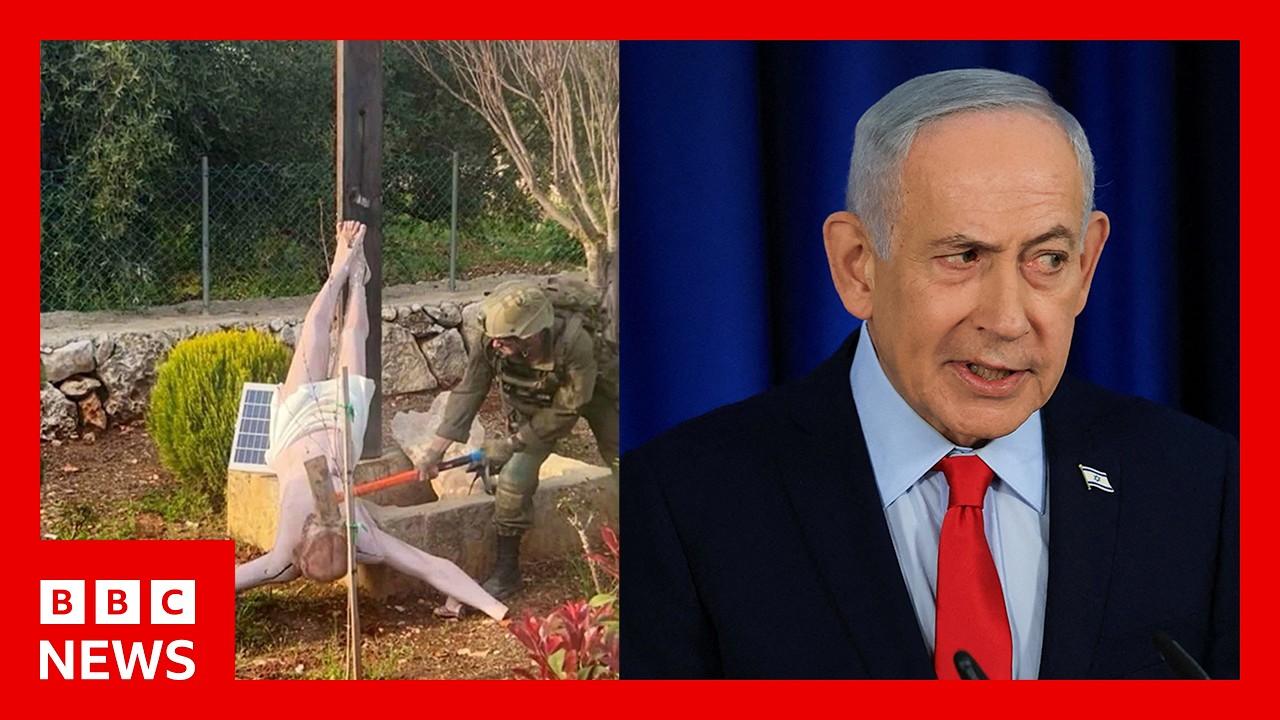
The recent actions of an Israeli soldier, who was captured on video smashing a statue of Jesus with a sledgehammer in a southern Lebanese village, have sparked international outrage and condemnation. Israeli Prime Minister Benjamin Netanyahu has publicly denounced the soldier’s actions, expressing deep regret for the distress caused to Christian communities both within Lebanon and around the world. This incident has surfaced amid complex geopolitical tensions that continue to simmer in the region.
The soldier’s act of vandalism occurred in the Maronite Christian village of Douma, where the statue had adorned a crucifix at the edge of a family’s property. The Israeli Defense Forces (IDF) confirmed that the soldier involved has been operating in southern Lebanon in recent days. This village, situated near territory claimed by Hezbollah, has thus far been a focal point of tensions between Israeli forces and the Lebanese Shiite group. A photograph widely circulated on social media shows the soldier poised to strike the statue, an image that has only amplified the backlash against the military.
Netanyahu’s quick response aimed not only to mitigate potential diplomatic fallout but also to address the deep-seated emotions this vandalism has stirred within Christian communities. In a message published on social media, the Prime Minister’s remarks underscored an urgent acknowledgment of the delicate religious sentiments in Lebanon, especially in light of the historical tensions between Israeli forces and local populations.
Gideon Sa’ar, Israel’s Foreign Minister, also expressed his condolences, extending an apology to Christians who may have felt offended or traumatized by the incident. The local Christian priest described the act as a desecration, emphasizing the emotional toll it has taken on the community. Such incidents can ultimately lead to broader repercussions, exacerbating existing tensions in a region already fraught with discord.
The vandalism arrives at a precarious time, as a fragile ceasefire has been established between Israel and Lebanon, mediated by the United States. Just last week, a declaration was made after coercive negotiations involving Hezbollah and crediting Iran for facilitating the agreement. However, this recent incident threatens to undermine the progress made in fostering peace.
The implications of this vandalism stretch far beyond the local community. The White House has indicated a willingness to host high-level peace talks between Israeli and Lebanese leaders, discussions crucial for a region that has remained technically at war since the inception of the state of Israel in 1948. Lebanese President Michel Aoun has confirmed plans for a delegation to attend these negotiations, aimed explicitly at addressing Israel’s occupation and restoring Lebanese military presence along the border.
Nevertheless, Israel’s objectives in these peace talks revolve around the disarmament of Hezbollah and establishing a definitive border with Lebanon. The juxtaposition of these goals with the realities on the ground complicates an already intricate situation. The attack on the statue serves as a reminder of the cultural and religious sensitivities at play and the importance of mutual respect in navigating the challenges of coexistence.
As discussions unfold, the repercussions of this incident will likely echo through diplomatic channels. The response from both governments, alongside community reactions, will shape the future of Israeli-Lebanese relations. For now, the Israeli soldier’s actions have amplified calls for accountability and respect, underscoring the intricate interplay between military operations, community sensitivities, and the broader quest for peace in the region.
In conclusion, the vandalism of the statue has not only provoked outrage but also reignited discussions about the delicate balance needed for peace. As efforts to mediate between Israel and Lebanon continue, the importance of understanding and respecting the region’s diverse religious and cultural landscape becomes ever more critical.