Key Developments in the U.S.-Israel-Iran Conflict: A Detailed Overview
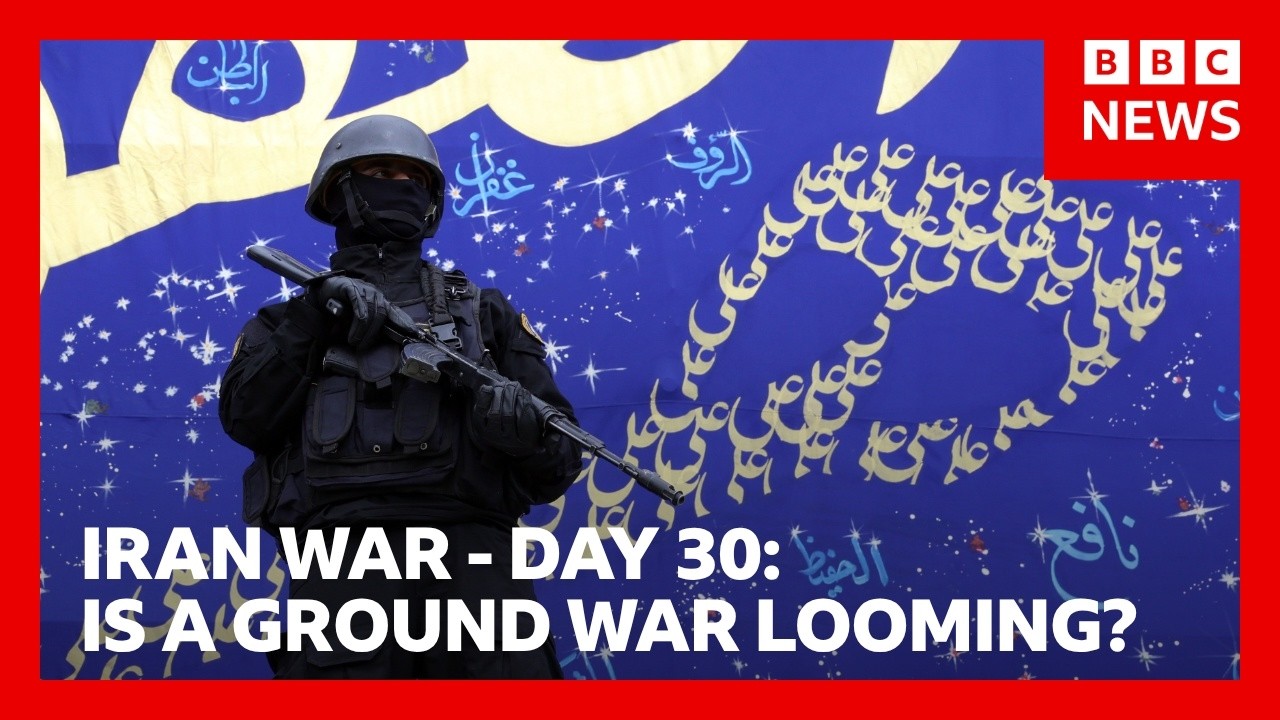
As the U.S.-Israel conflict with Iran enters its fourth week, the situation in the Middle East remains volatile. Day 30 of the ongoing war reveals significant developments that could reshape the landscape of the region. With rising tensions and mounting military engagements, the potential for escalation looms larger than ever.
Iran’s parliament speaker, Ali Larijani, recently accused the United States of secretly planning an invasion, a claim that has gained traction following reports suggesting the U.S. may deploy ground troops. This assertion follows the deployment of the USS Tripoli, an amphibious assault ship carrying approximately 3,500 military personnel, to the Gulf region—a move that underscores a heightened U.S. military presence. On the ground, Iran has launched missile attacks, resulting in fires at industrial sites in southern Israel, reportedly caused by missile shrapnel.
The war’s reach has also expanded to threatening cultural institutions. Iran’s leaders have issued warnings about striking American and Israeli universities in retaliation for attacks on Iranian academic institutions, highlighting a disturbing trend of targeting civilian infrastructure. This intensifying battle rhetoric signals an alarming shift, where educational establishments become battlegrounds in a geopolitical struggle.
Meanwhile, the deaths of three Lebanese journalists in an Israeli airstrike have further inflamed tensions. Their funeral in Beirut attracted large crowds, underscoring public outrage against Israel’s military actions and heightening calls for accountability. The portrayal of journalists as combatants, a strategy employed by the Israeli military, has faced significant condemnation. Organizations like the Committee to Protect Journalists have criticized these tactics, calling attention to the dangers posed to media personnel in conflict zones.
As speculation mounts regarding the potential deployment of U.S. ground troops, U.S. officials have offered mixed messages. While Secretary of State Marco Rubio emphasized that military options should remain open to President Trump, he assured the public that ground troops are not necessarily required to meet U.S. objectives in the region. This contradictory stance feeds into broader anxieties about America’s military strategy, especially given the unpredictable nature of President Trump’s decisions.
In the Gulf, the conflict’s implications are wide-reaching. Several attacks have targeted key infrastructure, prompting fears of economic repercussions. In response, Gulf nations, including Saudi Arabia and the UAE, have engaged their defenses against drone assaults and missile threats. These developments draw increasing scrutiny as regional players witness firsthand the destabilizing effects of a drawn-out conflict.
Diplomatic initiatives continue as foreign ministers from Turkey, Egypt, Saudi Arabia, and Pakistan convene in Islamabad to discuss potential de-escalation strategies. Despite these efforts, no significant breakthroughs have been noted between the U.S. and Iran, suggesting that diplomatic channels are strained at best. The Pakistani mediator role highlights Tehran’s interest in safe maritime traffic through strategically important waterways like the Strait of Hormuz, which Iran has agreed to open for a limited number of ships.
Domestically, U.S. political sentiments are fracturing over military involvement. While many Republican lawmakers have historically supported President Trump, there is growing resistance to ground troop deployment. This division reflects deeper fears about the lack of a coherent exit strategy from the war, complicating the already precarious situation.
As the conflict endures, international repercussions manifest in rising fuel prices, with various governments implementing emergency measures to alleviate economic strain. In Australia, for instance, public transport incentives are being introduced, while Egypt has enforced curfews to manage energy consumption amid rising costs.
In conclusion, the U.S.-Israel-Iran conflict has reached a pivotal moment filled with uncertainty and risk. As military operations intensify and diplomatic efforts struggle, the global ramifications of this war will likely reverberate far beyond the Middle East. The coming weeks will be crucial in determining whether the region can navigate this increasingly dangerous landscape without cascading into irrevocable chaos.