A Surprising Alliance: President Trump and Mayor Zoran Mamani
In an unexpected twist in American politics, President Donald Trump and New York City’s Democratic Socialist Mayor, Zoran Mamani, are forging a relationship that defies conventional political boundaries. Their latest meeting at the White House showcased this unusual alliance, with Mamani arriving prepared with props that he hoped would resonate with the president.
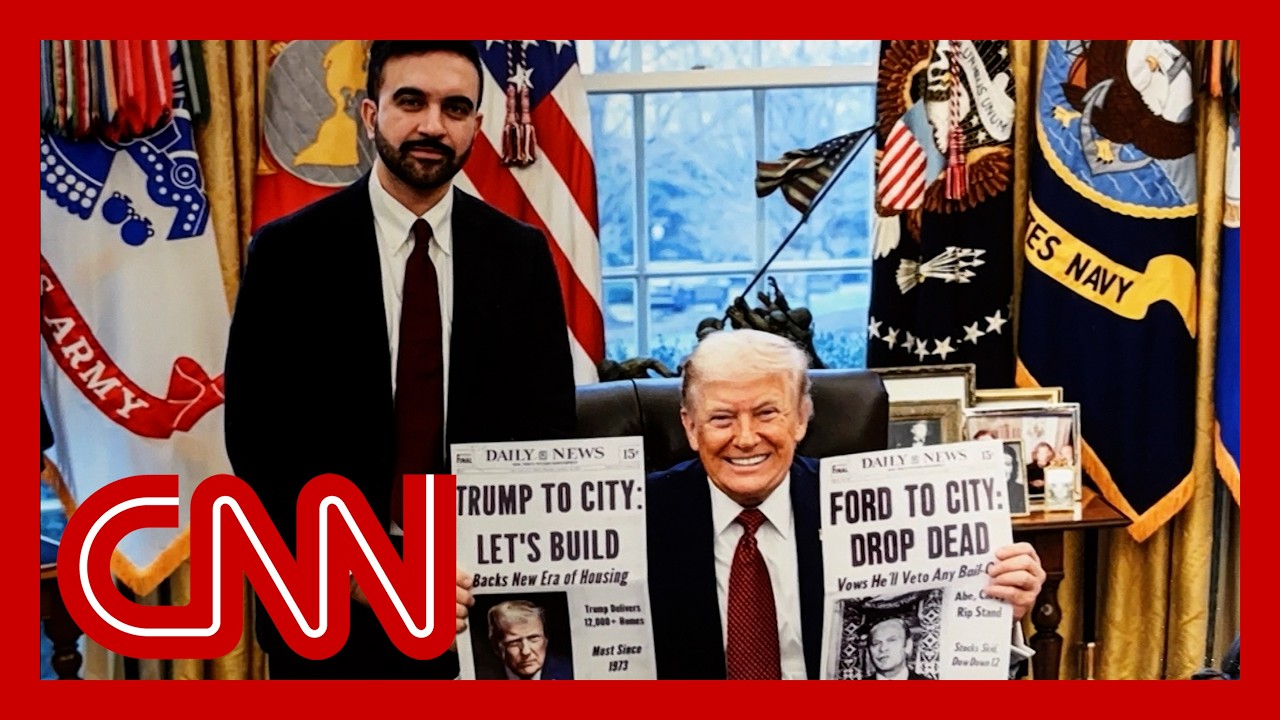
Mamani presented Trump with a mockup of a 1975 New York Daily News front page. The original featured then-President Gerald Ford alongside the provocative headline, “Ford to City: Drop Dead.” In contrast, Mamani’s version substituted Trump’s image with an optimistic message: “Trump to City: Let’s Build.” This clever juxtaposition was more than mere theatrics; it was part of Mamani’s pitch for a federally funded housing initiative aimed at addressing New York City’s pressing housing crisis.
The relationship between the two leaders is peculiar yet fascinating. Despite their stark ideological differences, Trump has openly praised Mamani, often referring to him playfully—if not inaccurately—as a communist. In his recent State of the Union address, Trump went as far as to remark, “Even the new communist mayor of New York City—I think he’s a nice guy.” This seemingly contradictory sentiment hints at a deeper compatibility between the two.
But how did a self-identified socialist manage to strike a chord with a former reality television star turned president? The dynamics of their liaison suggest a unique understanding of political maneuvering. Analysts point out that Mamani has discovered a method to engage Trump effectively, perhaps better than many politicians—both within and outside his party—have managed to.
The rapport between the two can be likened to two boys from Queens finding common ground. Mamani’s strategic use of props illustrates his ability to appeal to Trump’s preferences: flattery and grandiose ideas. While many politicians have a difficult time getting through to Trump, Mamani appears to communicate in a way that resonates with the president’s sensibilities. His audacity in bringing visual aids—such as the mocked newspaper headline—reveals a bold, innovative approach that captures Trump’s attention.
However, one must question the implications of this budding friendship. Will Mamani’s willingness to engage with a polarizing figure like Trump cost him political capital back home? Likely not, given that his core base would not interpret these overtures as an endorsement of Trump’s policies. Instead, they may perceive his approach as a tactical maneuver to secure needed resources for New York City—an astute political calculation amid an increasingly polarized political climate.
Interestingly, both men share a commonality in having challenged their respective political establishments, rising to prominence against the odds. This shared history of navigating political obstacles may enhance their mutual respect, even if their ideologies diverge sharply.
The recent meeting also highlights more practical political issues. Mamani, 34, embodies the spirit of a new generation of leaders who recognize the importance of collaboration across ideological lines, especially when addressing urgent issues like housing and immigration. During the meeting, he also successfully advocated for the release of an Azerbaijani student arrested by ICE in a controversial incident. This move showcased not only Mamani’s commitment to social justice but also his deft political maneuvering.
As Mamani seeks to leverage his connection with Trump to push forward initiatives that can secure funding for New York City, he is undoubtedly aware that public improvement projects resonate with Trump’s real estate background and populist appeal. Amid rising discontent about local infrastructure failures, such as unplowed snow, Mamani’s strategy of using the “building” narrative is particularly poignant.
In summary, the unusual alliance forged between President Trump and Mayor Zoran Mamani reflects a convergence of interests that transcends traditional political boundaries. Their emerging partnership is a testament to the complexities of modern governance, where collaboration, even among unlikely allies, can lead to tangible benefits for constituents. As Mamani continues to navigate this intricate relationship, the potential for substantial progress in urban development and immigration policy remains on the horizon, albeit mired in the complexities of their contrasting political philosophies.