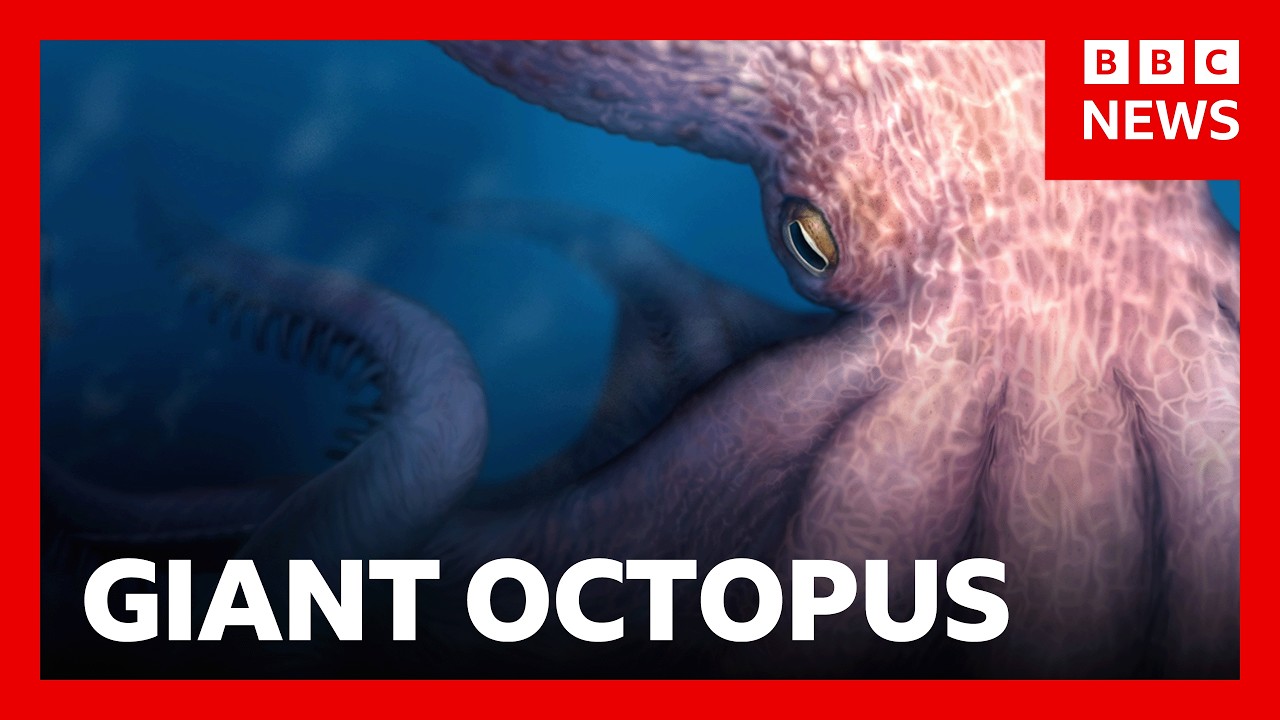
Giant Octopuses: Predators of the Ancient Seas
Recent findings from a study conducted by researchers at Hokkaido University in Japan suggest that giant octopuses may have had a place among the top predators of Earth’s oceans during the time of the dinosaurs, roughly 100 million years ago. This assertion not only captures the imagination but also recalibrates our understanding of marine life in that distant era.
The crux of this research rests on a remarkable discovery: a fossilized octopus jawbone, specifically a beak, measuring approximately eight centimeters in length. Unlike the small, fragile beaks of contemporary octopuses, this fossil’s size is comparable to and, indeed, larger than the beak of the modern giant squid. The presence of this beak leads scientists to hypothesize that the early octopuses were much larger and potentially more formidable than their present-day counterparts. If we extrapolate based on the size of the fossil, the estimated size of these marine giants could reach up to 19 meters.
Peter Godfrey-Smith, a noted philosopher and author of Other Minds: The Octopus, the Sea, and the Deep Origins of Consciousness, articulated some skepticism while discussing the findings in a recent radio interview. He emphasized that although the study proposes intriguing possibilities, it also calls for a cautious interpretation of the extrapolated data. “There’s a lot of extrapolation from that single marker,” he stated. Such extrapolations should be carefully scrutinized, especially since they transition from the fossil of a relatively small object to predictions of colossal creatures.
Moreover, Godfrey-Smith highlighted another layer to the argument: if these megafauna were indeed as large as proposed, they would have likely competed with other apex predators of the time, such as sharks and marine reptiles. This brings forth compelling questions about the ecological dynamics of prehistoric marine environments. Would these giant octopuses have outcompeted their contemporaries, or might they have adopted a more elusive lifestyle similar to modern-day giant squids, preferring to inhabit the depths of the ocean rather than engaging in surface-level confrontations?
The implications of such a revelation are profound. If these ancient octopuses were capable of growing to enormous sizes, it would reshape our understanding of predator-prey dynamics over millions of years. Ecosystems are intricate webs of interactions; the introduction of a top predator capable of immense size would have inevitably altered the dynamics among various marine species.
The fascination with octopuses extends beyond their physical attributes. As creatures known for their intelligence and adaptability, they raise compelling questions about consciousness in non-human animals. Godfrey-Smith’s work delves into the cognitive abilities of octopuses, noting that understanding their behavior and evolutionary journey can provide insights into the nature of intelligence across species.
This new research thus serves as a catalyst for further exploration into both the anatomy and behavior of prehistoric octopuses. As scientists continue to unearth and analyze fossil records, they may not only uncover more about ancient marine life but also reframe existing paradigms about oceanic ecosystems.
In conclusion, while the study presents an exhilarating notion that giant octopuses might have once been dominant predators in the seas, it also urges a careful approach to interpretation. The journey from fossil to understanding is complex and fraught with the uncertainties of extrapolation. Nevertheless, the prospect of titanic octopuses prowling ancient ocean depths ignites curiosity and inspires a deeper inquiry into the lives of these enigmatic creatures. Both their immense size and intelligence highlight a significant chapter in the evolutionary history of our planet’s oceans.