NASA Prepares for Historic Artemis 2 Moon Mission
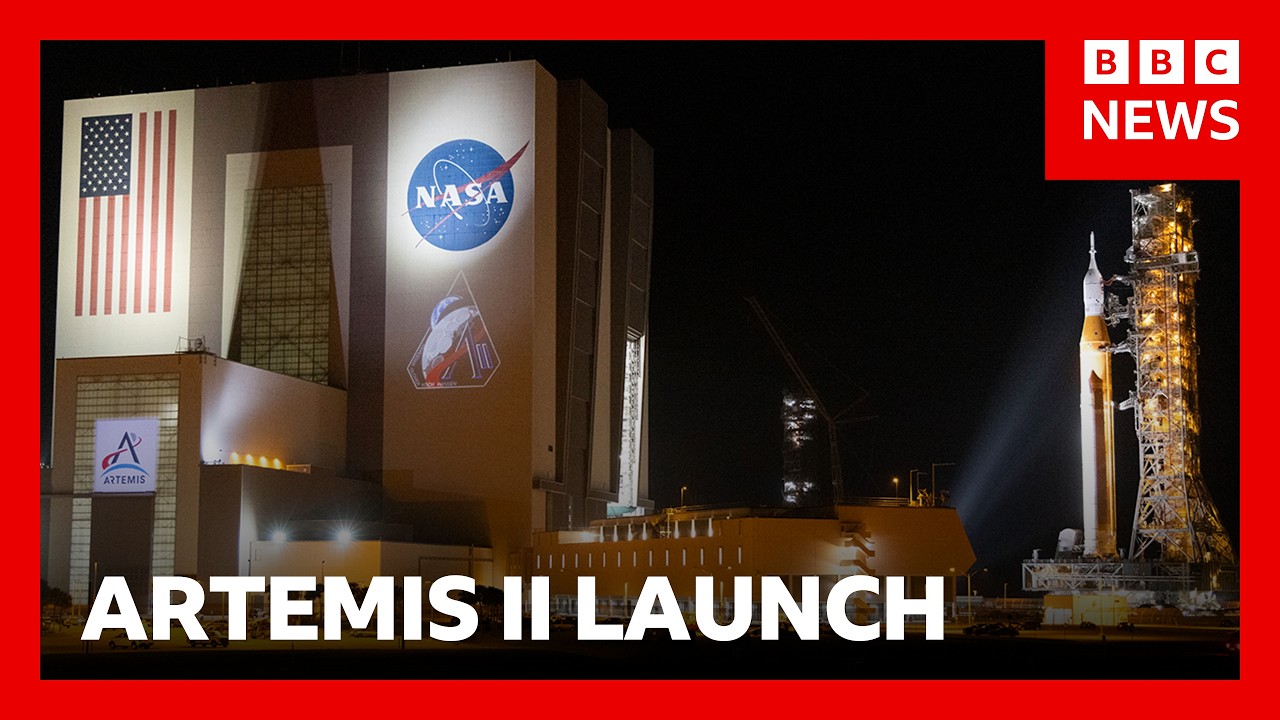
As NASA embarks on its ambitious journey back to the lunar surface, the excitement surrounding the Artemis 2 mission is palpable. With the mega rocket now rolling out of its warehouse to the launch pad at Kennedy Space Center, the endeavor signifies not only a return to the Moon but also a new era of space exploration.
NASA’s Artemis 2 rocket towers nearly 100 meters tall, a formidable structure designed for the challenges of deep-space travel. This behemoth is transported on a crawler transporter, making its way at a modest speed of just one mile per hour. The slow ascent from the facility to the launch pad is steeped in historical significance, marking the first phase of a mission that aims to redefine human presence beyond Earth.
The last time astronauts set foot on the Moon was in 1972 during the Apollo 17 mission. At that time, few could have predicted that a gap of over 50 years would separate humans from a lunar landing. With Artemis 2, NASA is taking important steps toward not only revisiting the Moon but also pushing the boundaries of human exploration.
Unlike its Apollo predecessors, Artemis 2 will not involve landing on the lunar surface. Instead, the crew—comprising NASA’s mission commander Reed Wiseman, Canadian astronaut Jeremy Hansen, and American astronauts Victor Glover and Christina Koch—will fly around the Moon’s far side. Over 10 days, they will travel approximately 250,000 miles away from Earth, setting a record for the furthest distance any humans have ventured from our planet.
"This mission will allow us to witness Earth from a unique vantage point," Wiseman remarked, emphasizing the profound experience of seeing our home planet as a singular sphere. "We will be going into an orbit almost right away that is 40,000 miles, like a fifth of the way to the Moon just in and of itself." Their journey isn’t merely a spectacle; it includes conducting scientific research and operations that will lay the groundwork for future explorations.
The Artemis program is a response to an intensifying global interest in lunar exploration. Notably, China has plans to land people on the Moon by 2030, adding a layer of competition to the race for lunar dominance. The pressure is on NASA to not only reclaim its position as a leader in space exploration but also to establish a sustainable human presence on the Moon. This drives the agency’s ambition to eventually build a lunar base that could serve as a springboard for more distant missions to Mars and beyond.
Although progress has been hindered by technical challenges, engineers report that the Artemis 2 rocket is ready for its monumental task. NASA’s ambitious timeline anticipates a launch in early April, a date that millions around the globe will be watching closely. The choice of a launch window is critical, ensuring that calculations related to orbital mechanics, fuel requirements, and safety are meticulously attended to before the countdown begins.
In preparing for this mission, the crew has undergone extensive training, involving simulations and rigorous rehearsals to ensure readiness. Their dedication exemplifies the intricate planning that precedes any space mission, where the stakes are immensely high.
As the world watches, NASA’s Artemis 2 will not just be a journey to the Moon; it symbolizes humanity’s relentless pursuit of knowledge and discovery. The mission embodies the idea that exploration is an essential part of our humanity. It reminds us that the universe is vast and that we are only beginning to uncover its secrets. In the face of challenges and competition, Artemis 2 stands as a beacon, reflecting the spirit of exploration and the enduring quest to venture into the unknown.