The American Perspective on Monarchy: A Diminished Interest
Less than a day ago, conversations pivoted around the phrase “the beauty of monarchy,” expressed by Richard Quest during a notable segment. As CNN’s chief data analyst, Harry, aptly noted, this phrase carries a different weight for American ears. In the United States, the perception of monarchy tends to be more skeptical, evoking thoughts of outdated power structures rather than fascination.
When exploring whether Americans find beauty in monarchy, the data reveals a stark reality. A mere 2% of independents, 4% of Republicans, and the same percentage of Democrats endorse the idea of a U.S. monarchy. To contextualize these numbers, consider that 12% of Americans believe in conspiracy theories such as the faked moon landing. The support for establishing a monarchy is significantly less popular—indicative of a historical aversion to hereditary rule in a nation founded on principles of democracy and republicanism.
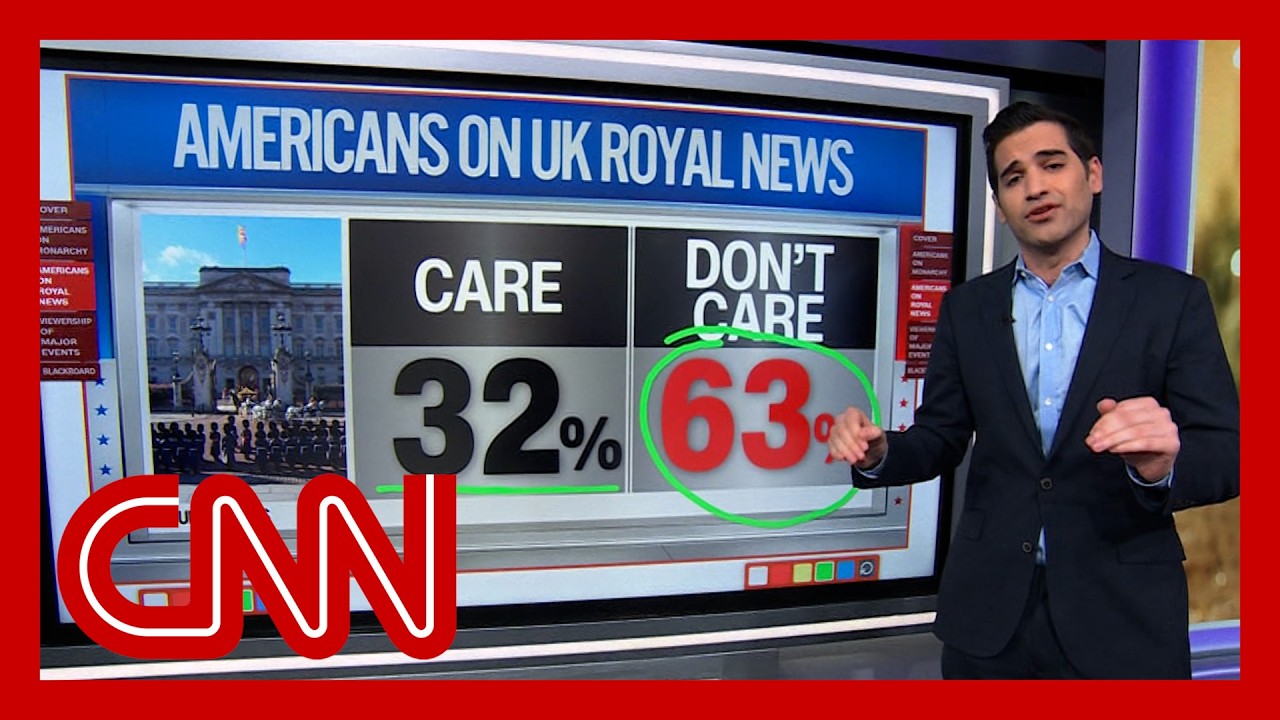
This disdain for monarchy is further emphasized by Americans’ attitudes toward royal news. A recent survey indicates that approximately 63% of Americans have grown weary of coverage about the British monarchy. The response to royal events, particularly those dominated by media fanfare, suggests an unwillingness to engage. For instance, the coronation of King Charles III attracted around 10 million viewers in the U.S., starkly overshadowed by the 126 million viewers of this year’s Super Bowl—an event emblematic of American culture.
Despite these figures, there is a fascination with the spectacle of monarchy underscored by nostalgia. Viewers flock to broadcasts of royal ceremonies, yet participation in these events seems more ceremonial than substantive. The statistics reveal a diminishing interest in the monarchy’s allure, with past royal ceremonies drawing significantly larger audiences. Queen Elizabeth II’s coronation, for instance, attracted triple the viewership compared to her son’s recent ascent.
The societal shift away from monarchy aligns with a broader historical context. The U.S. has strived to distance itself from royal hierarchies, a notion solidified during the Revolutionary War. There lies a sense of pride in this victory—both against British rule and in gaining viewership dominance over royal events.
During King Charles’s recent visit to the White House, discussions turned to diplomatic nuances amid geopolitical tensions. While the American media spotlighted the royal visit, critical observers pointed out the complexities of U.S.-UK relations. President Biden underscored the ongoing need for cooperation amid crises, hinting at a broader strategy that resonates with bipartisan interests. Yet, the views on the monarchy’s role remain mixed.
In a world defined by rapid social media updates and “edgelord diplomacy,” the event showcased a stark contrast. Here was a British monarch advocating for restraint and emphasizing historical ties while American politicians engaged in a parallel narrative of discord and partisanship. Such moments invite a reflection on the long-standing bond between the two nations, though often clouded by contemporary grievances.
Political leaders in the U.S. have expressed the need for mended bridges, particularly when faced with external challenges. Recent disagreements, notably concerning Iran and NATO, have painted a complex picture of diplomacy. Observers have noted that these tensions could hinder the anticipated camaraderie during royal visits.
Despite the complexities, the U.S.-UK relationship remains one of historical depth and mutual interest. The conversation surrounding monarchy highlights a broader philosophical divide. While many Americans view the monarchy as an archaic institution devoid of relevance, it symbolizes a tradition steeped in elegance and continuity for others. The challenge lies in reconciling these differing narratives.
As the dialogue continues, the marginalization of monarchy in American society becomes evident. While royal events serve as a talking point, they rarely translate to a wider endorsement of the institution itself. Rather, the historical context of the American Revolution amplifies a collective sentiment: pride in democratic principles over hereditary rule. Ultimately, the perceived beauty of monarchy remains a subject of curiosity rather than reverence in the United States, embodying a complex legacy that continues to evolve.